Scan-to-print for orthotics, prosthetics, insoles, and eyewear

From 3D scan to print-ready device, without a CAD engineer in the middle.

Turn the Grasshopper definition you use to design a custom-fit device into an online app your orthotists, prosthetists, podiatrists, fitters, or opticians can run themselves. They upload a scan, adjust what’s allowed, and get a print-ready model back - no Rhino, no CAD skills at the point of use.

14-day trial. No credit card.

scan.stlprinted orthosis
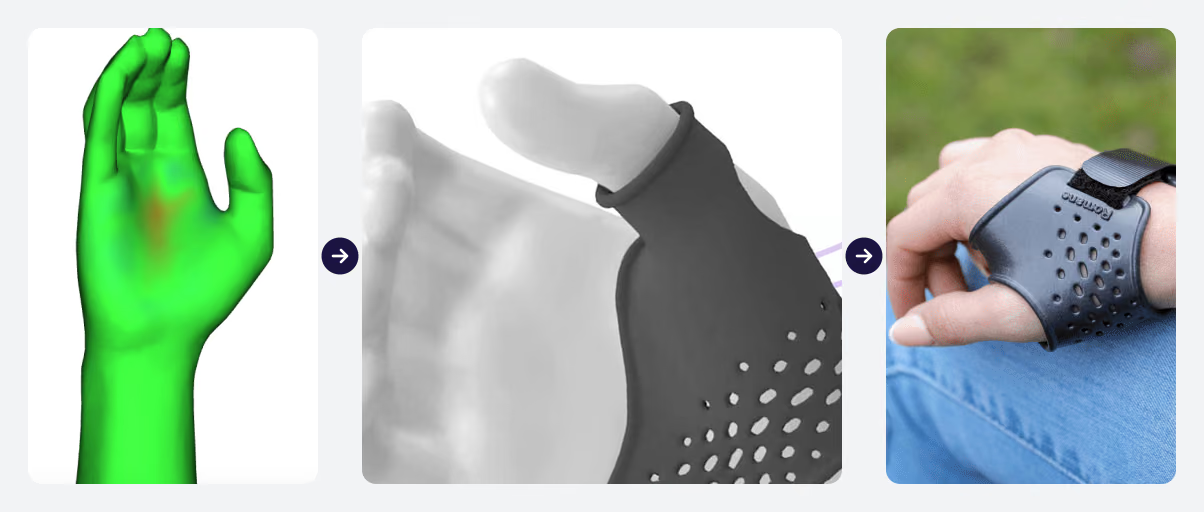
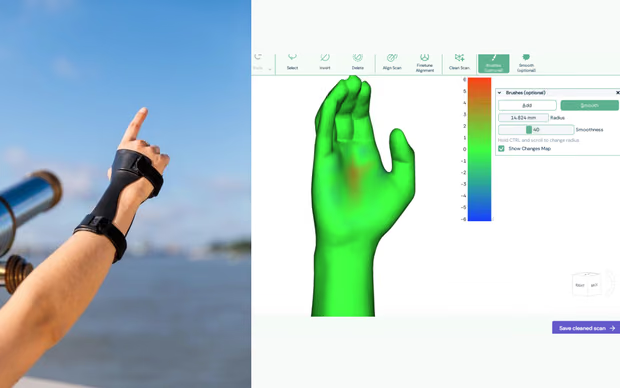
Three steps at OrthoSolid: a 3D scan of a hand, colored by how much the cleaning changed it; the same hand in the configurator with a perforated thumb orthosis fitted to it; and the printed orthosis worn on a wrist.
OrthoSolid: a hand scan, the orthosis fitted to it in the configurator, and the printed orthosis. Images courtesy of OrthoSolid.

The problem

The bottleneck is who can run the logic

In scan-to-print work, the hard part usually isn’t the Grasshopper definition - it’s that every case needs someone to drive it, and the people at the point of use (clinicians, fitters, opticians) don’t have Rhino and shouldn’t have to. So rectification and device design (reliefs, build-ups, trim lines, wall thickness) funnel back to one or two CAD-literate specialists, and that’s the ceiling on how many devices you can make. Scaling a bespoke device beyond what a few people can model by hand is where most teams get stuck.

Diagram: cases from the point of use all funnel to one or two CAD specialists, who become a queue in front of production

How it works

One definition, run in the cloud, for everyone who needs it

See how the platform works
  1. 01

    Scan or measurement in.

    The person at the point of use uploads a 3D scan or enters measurements through a simple browser interface.

  2. 02

    Your logic applies the modifications.

    Your Grasshopper definition applies your reliefs, build-ups, trim lines, and offsets to that specific scan in the cloud - the same logic every time.

  3. 03

    A clean interface.

    The interface is built in App Builder, so the clinician or fitter only sees the controls you choose to expose.

  4. 04

    Guardrails built in.

    Parameter limits and input checks stop out-of-range or non-manufacturable cases from reaching production.

  5. 05

    A fitted model comes back in seconds, in the formats your process needs - with the tolerances, wall thicknesses, and clearances you specified.

How this is different

Why a full CAD engine matters here

Diagram: a template snaps to the nearest preset size and misses the forefoot; a Grasshopper definition follows the actual scan with a fixed offset

vs. dedicated O&P CAD/CAM software

Rectification software gives an orthotist or prosthetist sculpting tools to modify each scan by hand, case by case. ShapeDiver suits teams that want to encode their own design rules for a device family: the definition applies them to every scan, and the clinician adjusts only what you expose.

vs. template or shape-morphing libraries

Those interpolate between preset shapes. A Grasshopper definition computes each device from the actual scan, so an unusual case isn’t forced to the nearest template.

vs. a visual configurator

Configurators pick from predefined options. Scan-to-print has to take an arbitrary scan as input and return unique geometry - that needs a real CAD engine, which is what runs behind ShapeDiver.

vs. building it yourself

You could host Rhino and Grasshopper, build a viewer, and write the UI, then own the servers, security, scaling, and maintenance indefinitely. ShapeDiver already runs all of that.

vs. modeling each case by hand

A specialist modeling every case is exactly the bottleneck you’re trying to remove. With ShapeDiver, one definition handles every case.

Whatever you build stays yours - you own the Grasshopper definition and can take it in-house or elsewhere at any time.

What comes out

Every run produces the files your process needs:

  • Meshes and solids STL, 3MF, STEP
  • Machine and cut files G-code, DXF
  • Drawings or data sheets PDF, CSV

Because the whole chain is automated, the geometry that reaches the printer is generated by the same logic every time. And through our APIs and SDKs, that output can flow straight into your order-management or ERP system.

See the platform and APIs
Diagram: a section through a fitted insole, with 0.5 mm clearance to the scan surface and a 2.0 mm wall, exported as STL, 3MF, or STEP

Customers

Teams already scaling this way

Read more customer stories
A hand with a black OrthoSolid orthosis, pointing at the sky, next to OrthoSolid’s configurator, where a patient’s hand scan is cleaned and smoothed before the orthosis is fitted
Belgium

Orthoses and prostheses, from a scan or measurement instead of a plaster cast.

“ShapeDiver is the crucial link between our designs and our clients.”

The OrthoSolid team

Read the OrthoSolid storyImages courtesy of OrthoSolid.

United Kingdom

Foot scans turned into production-ready footwear.
Read the story

Switzerland

An O&P provider running the workflow across ten locations.

Japan

3D-printed prosthetics delivered across Asia, with clinics in India and the Philippines - from a remote scan to a finished socket in a day, by the company’s own account.

The business case

What changes when the specialist is no longer the bottleneck

Serve more cases without hiring in step

Capacity stops being tied to the number of CAD-literate people on staff.

Consistent output at volume

The same logic runs for every case, so the process is repeatable and easier to document in your own quality system, for example under ISO 13485.

Lead time

-

To be measured with customers.

Devices per technician per week

-

To be measured with customers.

Trust & security

Fits a regulated workflow

ShapeDiver is the design tool, not the manufacturer of your devices. You remain the manufacturer, and you validate the definition and the app in your own quality system, as you would any software used in production. Your definition stays private on our servers and is never exposed to the people using the app. Parameter limits and input checks keep every case within the ranges you set. Everything runs on SOC 2® Type II audited infrastructure, with cloud regions in the EU, the US, and Asia - and Enterprise customers can run on a dedicated, isolated environment.

Security & Trust
Diagram: the platform runs on SOC 2 Type II audited infrastructure with regions in the EU, the US, and Asia, plus dedicated environments for Enterprise

Who it's for

Where scan-to-print fits

  • 01O&P practices and central fabrication labs AFOs, KAFOs, spinal braces, hand and wrist orthoses, prosthetic sockets, cranial helmets
  • 02Podiatry and pedorthic labs Custom foot orthoses and insoles
  • 03Footwear brands Lasts, midsoles, and insoles from foot scans
  • 04Custom-fit eyewear and consumer products Frames fitted in store, sports equipment, hearing aids, wearables
  • 05Additive-manufacturing service bureaus MJF and SLS production in PA11 and PA12
  • 06Device teams with a computational designer who has the definition but needs to put it in more hands

Getting started

Ways to begin

Self-serve

You already know Grasshopper.

Start a free trial, upload your definition, and see it running as an app in minutes.

With our team

You’d like help with the definition.

Our team can build or optimize the Grasshopper definition with you - mapping out one device family from scan to print, then deploying it at a pilot site and iterating. You keep what we build.

Ready-made

You’d rather use a ready solution than build one.

Some of our customers offer their own white-labeled, ShapeDiver-based applications. Tell us what you need and we can connect you with an existing solution provider.

Whichever route you take, a new version of the definition reaches the people using the app only when you publish it - and you’re never locked in.

FAQ

Questions teams ask

Do the people running it need Rhino or CAD skills?

No. At the point of use it’s a browser app; the CAD runs in the cloud.

Who actually drives it day to day?

Your orthotists, prosthetists, podiatrists, fitters, or opticians, through an interface that shows only the controls you choose to expose.

Does this replace our O&P CAD or rectification software?

Not necessarily. Rectification software is built for modifying each scan by hand, and many clinics keep it for that. ShapeDiver fits where a device family follows rules you can write down, such as insoles, cranial helmets, or a standard AFO design: the definition applies them to every scan. You can start with one device family and keep the rest in your current software.

Which scanners and file formats work?

Most scanners do, because the app takes the mesh they export: OBJ, STL, PLY, and most other formats Rhino can import. Your definition can clean and align the scan before it fits the device, whichever scanner took it. The result comes back as STL, 3MF, or STEP.

Which printers and materials does the output suit?

Any process that takes a mesh: HP Multi Jet Fusion, SLS, FDM, or resin. Wall thicknesses, clearances, and lattice or perforation patterns come from your definition, so you set them for your printer and material, for example PA11, PA12, or TPU.

How do we control changes to the definition?

You decide when a change goes live: the people using the app keep working with the current version until you publish a new one. The definition runs the same logic every time, with parameter limits and input checks that stop out-of-range cases before they reach production. Validating each version and documenting the change stay with you, in your own quality system. Your definition stays private.

Is ShapeDiver a medical device?

No. ShapeDiver is the software platform your definition runs on; it doesn’t design a device on its own. You remain the manufacturer of the devices you make with it, for example of custom-made devices under the EU MDR, and you validate the definition and the app in your own quality system.

Can it connect to our order or ERP system?

Yes - through our APIs and SDKs, so output and order data can flow into your existing systems.

Where is our data hosted?

On SOC 2 Type II audited infrastructure, with cloud regions in the EU, the US, and Asia. Enterprise customers can run on a dedicated, isolated environment.

We don’t have a Grasshopper definition yet - can you help?

Yes. Our Professional Services team can build or co-build it with you, and you own the result. Projects start with a short Specification Stage, which gives you a fixed price for the whole build.

Scan-to-print

See your own workflow running online

Start a free trial and put one of your own definitions in front of the people who need it - or talk to us if you’d like help getting the definition right first.

Talk to our team

Your Business

How can we help?
